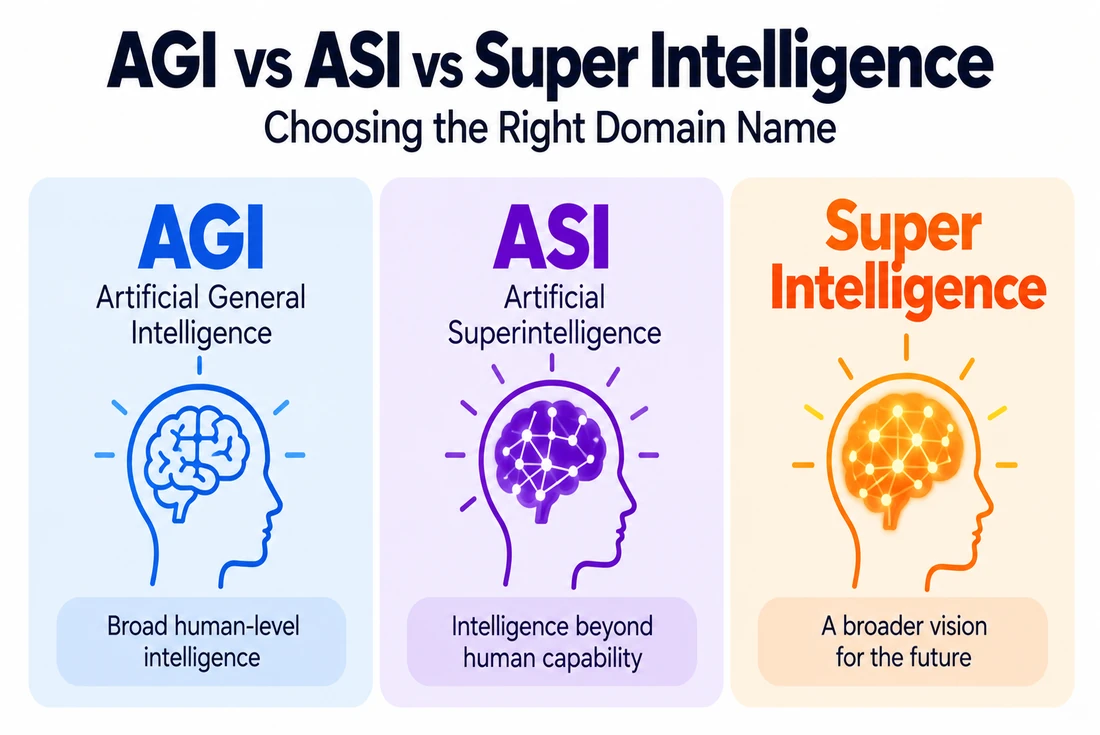
AI founders increasingly encounter three closely related terms:
AGI.
ASI.
Super Intelligence.
They may sound similar, but they do not communicate exactly the same thing.
That difference matters when choosing a startup name.
A company building toward Artificial General Intelligence may want very different positioning from a company explicitly researching Artificial Superintelligence. Another founder may prefer the broader phrase Super Intelligence because it provides more flexibility as a brand.
If you are considering an AGI vs ASI domain strategy, the first question should not be which abbreviation sounds more futuristic.
The better question is:
What does your company actually intend to build, and which name gives it enough room to grow?
This guide explains the differences between AGI, ASI and Super Intelligence from a startup naming and domain perspective.
It also explores .COM, .AI, .SI and other domain options for founders building technologies around reasoning, autonomous agents, intelligence infrastructure, AI safety, robotics and increasingly capable machine intelligence.
Quick Answer: AGI vs ASI vs Super Intelligence
AGI – Artificial General Intelligence generally refers to a hypothetical AI system capable of performing broadly across intellectual tasks at roughly human-level capability or beyond.
ASI – Artificial Superintelligence refers to a hypothetical form of AI whose general intellectual capabilities substantially exceed those of humans.
Super Intelligence is a broader phrase that can refer to the idea of intelligence beyond ordinary human capability and can also function as a technology or branding concept.
As of September 2026, there is still no universally accepted declaration that AGI or ASI has been achieved. Definitions of AGI also vary across researchers and organisations.
For startup naming:
- AGI communicates general intelligence.
- ASI communicates an even stronger future capability claim.
- Super Intelligence can provide a broader, more brand-friendly concept.
- A neutral brand may provide more flexibility than any of the three.
The strongest domain should represent the company without making claims the technology cannot support.
What Is AGI?
AGI stands for:
Artificial General Intelligence
The term generally describes AI capable of applying intelligence broadly across many kinds of intellectual tasks rather than being restricted to a narrow speciality.
IBM describes AGI as a hypothetical stage where AI could match or exceed human cognitive abilities across tasks, while also noting that researchers do not share one universally agreed definition.
IBM: What Is Artificial General Intelligence?
Google DeepMind has similarly described AGI in terms of highly general capabilities and has developed frameworks considering dimensions such as performance, generality and autonomy.
The important word for founders is:
general.
AGI is not simply an AI system that performs one task extremely well.
The concept involves intelligence capable of operating across many different kinds of problems.
What Is ASI?
ASI stands for:
Artificial Superintelligence
This is a substantially stronger concept.
ASI generally refers to hypothetical artificial intelligence whose cognitive capabilities exceed human intelligence across a very broad range of tasks.
IBM describes ASI as a hypothetical AI system with intellectual capabilities beyond those of humans.
IBM: What Is Artificial Superintelligence?
Google DeepMind published research in June 2026 examining possible pathways from AGI toward ASI, including scaling, paradigm shifts, recursive improvement and large multi-agent systems.
Google DeepMind: From AGI to ASI
The key distinction for branding is therefore:
AGI → broadly human-level general intelligence
ASI → intelligence beyond human-level general capability
These remain future-oriented concepts rather than ordinary descriptions of today’s commercial AI software.
What Does Super Intelligence Mean?
Super Intelligence is less rigid as a branding phrase.
It can refer generally to intelligence exceeding normal human capabilities.
Within AI discussions, it is often closely associated with Artificial Superintelligence.
But as a startup identity, Super Intelligence can also operate as a broader umbrella concept.
A company could be building technology around:
- advanced reasoning
- autonomous agents
- machine cognition
- scientific intelligence
- agent coordination
- robotics
- AI safety
- intelligent infrastructure
- machine memory
- verification
- alignment
- future computing
without claiming that it has already created ASI.
That difference can make Super Intelligence particularly useful from a branding perspective.
AGI vs ASI: The Simple Difference
A useful simplified model is:
AGI
Generally capable intelligence comparable with human intellectual capability across many domains.
ASI
General intelligence substantially exceeding human intellectual capability.
This is necessarily simplified because researchers disagree about precise thresholds and definitions.
But it is enough for a founder making a naming decision.
AGI says:
We are interested in general intelligence.
ASI says:
We are interested in intelligence beyond human capability.
Those are very different brand promises.
AGI vs ASI Domain Strategy
An AGI vs ASI domain decision should begin with your company’s actual mission.
Imagine two companies.
Company A
Its mission is:
Build generally capable digital workers able to learn and operate across many enterprise tasks.
AGI-related branding might reasonably align with that ambition.
Company B
Its mission is:
Research machine intelligence capable of eventually exceeding human scientific reasoning.
ASI or Super Intelligence positioning may align more naturally.
Now consider Company C:
Build an AI scheduling tool for dental practices.
Neither AGI nor ASI is probably necessary.
The company can simply build an excellent AI product.
The domain should follow the company.
The company should not be redesigned around a fashionable abbreviation.
AGI Carries a Significant Claim
Founders should be cautious about using AGI casually.
Calling a product:
AGI Platform
or:
AGI Engine
creates expectations.
People may reasonably assume the technology is genuinely pursuing general intelligence rather than another specialised AI application.
This can affect:
- customer expectations
- technical credibility
- investor conversations
- media interpretation
- recruiting
- research positioning
If AGI is genuinely central to the company, that association may be valuable.
If it is merely marketing language, it may weaken credibility.
ASI Carries an Even Bigger Claim
The same concern is stronger with ASI.
Artificial Superintelligence describes an extraordinary hypothetical level of machine capability.
A conventional AI SaaS company adopting an ASI-heavy brand may therefore create a significant mismatch between:
brand promise
and:
actual product capability.
This does not mean founders cannot build brands around the future ASI ecosystem.
A company may legitimately be developing:
- ASI safety
- ASI infrastructure
- ASI governance
- superalignment
- evaluation systems
- intelligent compute
- autonomous research
- advanced reasoning
without claiming to have created Artificial Superintelligence itself.
Precision matters.
Super Intelligence Can Offer More Branding Flexibility
This is one reason Super Intelligence may work differently.
The phrase can function as an emerging technology category as well as a future-oriented branding concept.
For example, a founder could describe a company as:
Building infrastructure for the future Super Intelligence ecosystem.
That is different from saying:
We have built ASI.
The first describes a market direction.
The second makes a technological claim.
For startup branding, that distinction can be extremely useful.
Should You Put AGI in Your Startup Name?
Sometimes.
AGI may fit companies whose mission genuinely revolves around:
- general reasoning
- broadly capable agents
- human-level machine intelligence
- cognitive architectures
- general-purpose autonomous systems
- AGI research
- AGI safety
- AGI infrastructure
But founders should consider whether the term creates unnecessary limitations.
Suppose your company eventually becomes a major robotics or computing business.
Will an AGI-specific name still fit?
Maybe.
Maybe not.
Should You Put ASI in Your Startup Name?
The threshold should probably be even higher.
ASI can make sense for:
- Artificial Superintelligence research
- ASI safety
- ASI governance
- long-term alignment
- superintelligence infrastructure
- frontier intelligence research
But a startup should understand that the abbreviation is not yet as broadly recognised outside advanced AI communities as AI.
That creates a trade-off.
ASI may provide:
specificity
but lose:
immediate mainstream understanding.
Should You Use “Super Intelligence” Instead?
For some companies, yes.
Super Intelligence has several branding advantages.
It is understandable in ordinary English.
It sounds less like an unexplained acronym.
It can cover multiple future intelligence technologies.
It provides room between today’s AI and a strict claim of achieved ASI.
It also creates interesting domain possibilities.
This is the broader theme behind What Are Super Intelligence Domains?.
What About a Completely Neutral Brand?
This may be the strongest option of all.
A frontier intelligence company does not need:
AGI
ASI
AI
or:
Super Intelligence
inside the company name.
Consider conceptual territories such as:
reason
mind
logic
proof
discovery
memory
trust
vision
motion
knowledge
These concepts can describe something fundamental about intelligence without tying the company to today’s terminology.
That can be extremely valuable over ten or twenty years.
The Vocabulary of AI Will Continue Changing
This is easy to underestimate.
Technology terminology evolves rapidly.
Companies once positioned around:
machine learning
then:
deep learning
then:
generative AI
then:
LLMs
then:
agents
and increasingly:
reasoning
autonomy
AGI
Super Intelligence
The terminology founders use in 2035 may differ significantly from what feels modern in 2026.
A durable domain should ideally survive those vocabulary shifts.
The Ten-Year Test
Before buying an AGI or ASI-related domain, imagine the company ten years from now.
Perhaps today you build:
AI reasoning software
Later you develop:
autonomous agents
Then:
general intelligent systems
Then:
robotics
Then:
scientific computing infrastructure
Does the original domain still make sense?
If yes, that is a strong sign.
If not, you may be naming the first product rather than the company.
AGI Domain Names
AGI-oriented founders might naturally explore concepts relating to:
Generality
general
universal
open
broad
whole
Cognition
mind
brain
reason
logic
think
Learning
learn
adapt
evolve
discover
Autonomy
agent
act
pilot
operator
Knowledge
know
wisdom
memory
sense
These are conceptual naming directions, not statements about domain availability.
A founder should evaluate the complete brand rather than simply attaching AGI to a keyword.
ASI Domain Names
ASI-related naming may lean more heavily toward concepts such as:
Advanced Intelligence
super
beyond
meta
next
higher
Reasoning
reason
infer
solve
logic
Intelligence Safety
align
guard
safe
proof
trust
Advanced Systems
core
stack
grid
mesh
node
Autonomous Intelligence
agent
motion
act
pilot
execute
Again, the best brand may never explicitly include the letters ASI.
Super Intelligence Domain Names
Super Intelligence creates an even broader naming universe.
Potential domains can relate to:
- intelligence
- reasoning
- agents
- cognition
- safety
- robotics
- scientific discovery
- infrastructure
- autonomy
- verification
- governance
That is why DaaZ treats Super Intelligence as a technology discovery category, rather than merely searching for domains containing the words “Super Intelligence.”
Founders can explore the DaaZ Super Intelligence Domains category.
.COM for AGI and ASI Startups
.COM remains particularly interesting for frontier AI companies because it does not depend on a technology label.
A company could move from:
AGI research
to:
robotics
to:
scientific infrastructure
to:
general computing
while keeping the same .COM brand.
This flexibility has significant long-term value.
The main disadvantages are:
- scarcity
- acquisition cost
- competition for strong words
Many exceptional .COM domains are already owned.
Founders can explore aftermarket inventory through the DaaZ domain marketplace.
.AI for AGI Startups
.AI has a major advantage:
immediate recognition.
A founder using:
brand.ai
does not need to explain that the business relates to Artificial Intelligence.
That makes .AI attractive for:
- AGI research
- agent companies
- reasoning startups
- frontier AI labs
- AI infrastructure
- machine intelligence platforms
Even if the company ultimately aims at AGI, .AI can remain perfectly appropriate.
AGI is still Artificial Intelligence.
.AI for ASI Startups
The same principle applies to ASI.
An Artificial Superintelligence company can absolutely use .AI.
The extension describes the broad technology category.
It does not have to describe the precise capability level.
That can actually be an advantage.
The company retains a familiar domain identity while communicating its more ambitious mission through branding and messaging.
.SI for Super Intelligence
.SI presents a different possibility.
Officially, .SI is Slovenia’s country-code extension.
It is not officially designated as a Super Intelligence extension.
However, in technology branding:
SI can naturally mean Super Intelligence.
That creates an interesting semantic identity:
brand.si
could potentially communicate:
Brand + Super Intelligence
This is an emerging creative interpretation rather than an established convention.
We explore that distinction in Why .SI Could Become a Natural Domain Extension for Super Intelligence.
Could .SI Work for ASI?
Potentially.
ASI contains the words:
Artificial Superintelligence
while .SI can creatively represent:
Super Intelligence
That means an ASI-focused startup could potentially use .SI without placing the full ASI abbreviation directly in its domain.
The resulting identity may feel simpler.
But again, the underlying word is critical.
A poor name does not become strong simply because it ends in .SI.
AGI vs ASI vs Super Intelligence Domain Extensions
A simplified comparison looks like this:
| Strategy | Potential Strength |
|---|---|
| .COM | Broad, technology-neutral global branding |
| .AI | Immediate Artificial Intelligence recognition |
| .SI | Emerging Super Intelligence interpretation |
| Other TLDs | May provide stronger individual brand combinations |
The mistake would be deciding:
We are an ASI startup, therefore we must use
.SI.
There is no such rule.
The complete domain always matters more.
Do You Need AGI.com-Type Exact-Match Domains?
Not necessarily.
Exact-match category domains can be powerful.
But startups do not have to own the exact generic phrase describing their market.
A company building toward AGI can have a distinctive brand.
A company working on ASI safety can use a trust-oriented name.
A Super Intelligence company can use a conceptual dictionary word.
Often that approach creates a more defendable and memorable identity.
Category Name vs Company Name
This distinction is critical.
Artificial General Intelligence may be the category.
Your company name can be something else.
Artificial Superintelligence may be the research direction.
Your company name can still be something else.
Think about the difference between:
what the technology is called
and:
what the company should be called.
They do not need to match.
Search by Keyword or Discover by Concept?
AGI and ASI demonstrate the limitations of traditional domain search particularly well.
A founder may know:
We are developing long-term memory and autonomous reasoning for general-purpose agents.
But what should they type into a search box?
AGI?
memory?
reason?
agent?
mind?
autonomy?
cognition?
All could be relevant.
This is why DaaZ AI Domains Discovery approaches naming through technologies and concepts rather than relying entirely on literal keyword matching.
Domain Discovery for Frontier AI Startups
A strong discovery system should understand relationships.
For example:
AGI
relates to:
reasoning
generality
learning
memory
autonomy
cognition
ASI
relates to:
advanced intelligence
alignment
safety
superintelligence
control
governance
Autonomous agents
relate to:
action
execution
planning
orchestration
tools
These relationships can reveal brand candidates the founder would never have manually searched.
That is fundamentally different from ordinary availability search.
What If the Best Domain Is Already Registered?
Registration does not necessarily mean the domain cannot be purchased.
Many high-quality names are owned by:
- investors
- companies
- individuals
- previous projects
Some are listed publicly for sale.
Others may be obtainable through negotiation.
You can browse domains for sale on DaaZ.
For the wider acquisition process, read How to Buy a Super Intelligence Domain Name.
Should You Pay a Premium?
A domain can deserve a premium price when it provides exceptional branding value.
Consider:
- brevity
- meaning
- pronunciation
- spelling
- commercial relevance
- global usability
- extension
- long-term flexibility
- alternatives
Do not pay more merely because the seller describes a domain as an AGI or ASI domain.
The domain itself must justify the value.
You can also explore curated names through DaaZ Diamonds.
Lease to Own for Frontier AI Startups
Premium domains can compete with other important startup expenses.
Founders may need capital for:
- engineering
- compute
- cloud infrastructure
- hiring
- legal work
- sales
- marketing
Where offered, Lease to Own can spread a domain acquisition across multiple payments.
That can preserve more capital during an important stage of company development.
The founder should still ensure the complete payment plan is affordable.
Buying Directly From a Domain Owner
Some founders contact domain owners independently.
Once price and terms have been agreed, both parties still need a safe way to exchange payment and transfer the domain.
DaaZ Secure provides a structured transaction option for independently negotiated domain sales.
For valuable domains, secure transfer mechanics should be part of the acquisition strategy from the beginning.
Avoid Overclaiming in the Brand
This deserves repeating.
If your company is building a chatbot, do not imply that you have created ASI merely because the terminology attracts attention.
If your company is building an autonomous agent, do not automatically call it AGI.
A strong brand can be ambitious without being misleading.
Founders should aim for:
future-facing but credible.
That balance becomes particularly important in frontier AI.
A Simple AGI vs ASI Domain Decision Framework
Before choosing the domain, answer these questions.
1. Are we genuinely building toward general intelligence?
If no, AGI branding may be unnecessary.
2. Are we genuinely working on intelligence beyond human capability?
If not, avoid presenting the product as ASI.
3. Are we building infrastructure for that future?
Then Super Intelligence, AGI or ASI ecosystem positioning may still be relevant.
4. Will customers understand the abbreviation?
AI is widely recognised.
AGI is less universal.
ASI is even more specialised.
5. Does the brand work without the acronym?
Ideally, yes.
6. Will the name survive changes in AI terminology?
This matters enormously.
7. Which complete domain is strongest?
Compare the word, extension, price and alternatives together.
Frequently Asked Questions
What does AGI mean?
AGI stands for Artificial General Intelligence.
It generally refers to hypothetical AI with broad capabilities across many intellectual tasks rather than being limited to a narrow domain. Precise definitions vary among researchers.
What does ASI mean?
ASI stands for Artificial Superintelligence.
It generally refers to hypothetical artificial intelligence whose broad intellectual capabilities exceed those of humans.
Has AGI been achieved?
There is no universally accepted determination that AGI has been achieved. Definitions and proposed thresholds remain debated, and IBM’s July 2026 overview continues to describe AGI as hypothetical.
Has ASI been achieved?
No established ASI system is recognised today. ASI continues to be discussed as a hypothetical future form of machine intelligence.
What is the difference between AGI and ASI?
In simplified terms, AGI focuses on broad general intelligence at approximately human-level capability or beyond, while ASI refers to general intelligence substantially exceeding human capability. Definitions are not completely standardised.
Is Super Intelligence the same as ASI?
They are often closely related in AI discussion, but Super Intelligence can also be used as a broader descriptive or branding phrase.
ASI has the more specific expansion:
Artificial Superintelligence.
What is the best AGI vs ASI domain extension?
There is no universally best extension.
.COM offers broad branding flexibility.
.AI provides immediate AI recognition.
.SI can creatively support a Super Intelligence interpretation.
The strongest complete domain should determine the choice.
Should an AGI startup use .AI?
It can.
AGI remains a concept within Artificial Intelligence, so .AI can be a natural fit.
Should an ASI startup use .SI?
It can consider .SI, especially when the complete domain creates strong Super Intelligence branding.
However, .SI officially remains Slovenia’s country-code extension; Super Intelligence is a creative technology interpretation.
Where can I find AGI, ASI and Super Intelligence domains?
Founders can explore the DaaZ domain marketplace, AI Domains Discovery and the dedicated Super Intelligence Domains category.
AGI vs ASI Domain Naming: Build for the Company You Want to Become
The AGI vs ASI domain decision should never begin with an acronym.
It should begin with the company.
AGI represents the pursuit of broadly capable general intelligence.
ASI represents a much more ambitious hypothetical level of intelligence beyond humans.
Super Intelligence provides a broader concept that can sometimes work more naturally as a technology brand.
But a startup does not need any of those terms in its company name.
A short conceptual brand on .COM may be strongest.
A technology-native .AI may be perfect.
An emerging .SI identity may fit a company deliberately building around Super Intelligence.
Or another extension may produce the best complete brand.
The domain should support the company’s ambition without exaggerating what exists today.
Think beyond the first product.
Think beyond today’s AI vocabulary.
And choose a name capable of surviving the journey from the technology you are building now to the company you hope to become.
Explore Super Intelligence Domains
Browse Domains for Sale on DaaZ
Explore Premium Domains on DaaZ Diamonds
Disclaimer
Domain names displayed in article images or examples are shown for illustrative, educational and editorial purposes only. Their inclusion does not mean that the domains are owned by DaaZ, listed for sale on the DaaZ marketplace, available for purchase or endorsed by their respective owners. Readers should independently verify the current ownership, availability, trademark status and sale status of any domain before taking action.